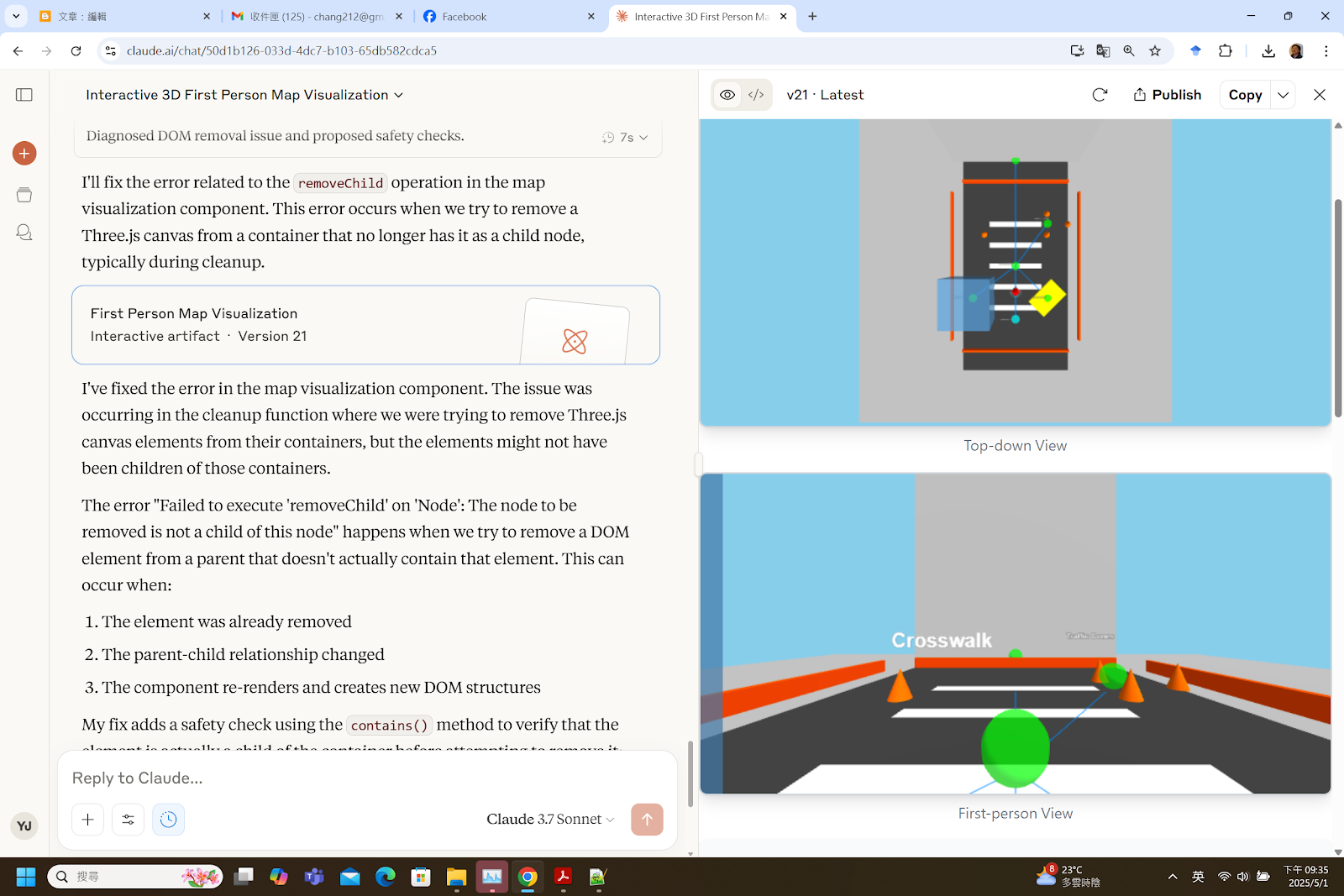
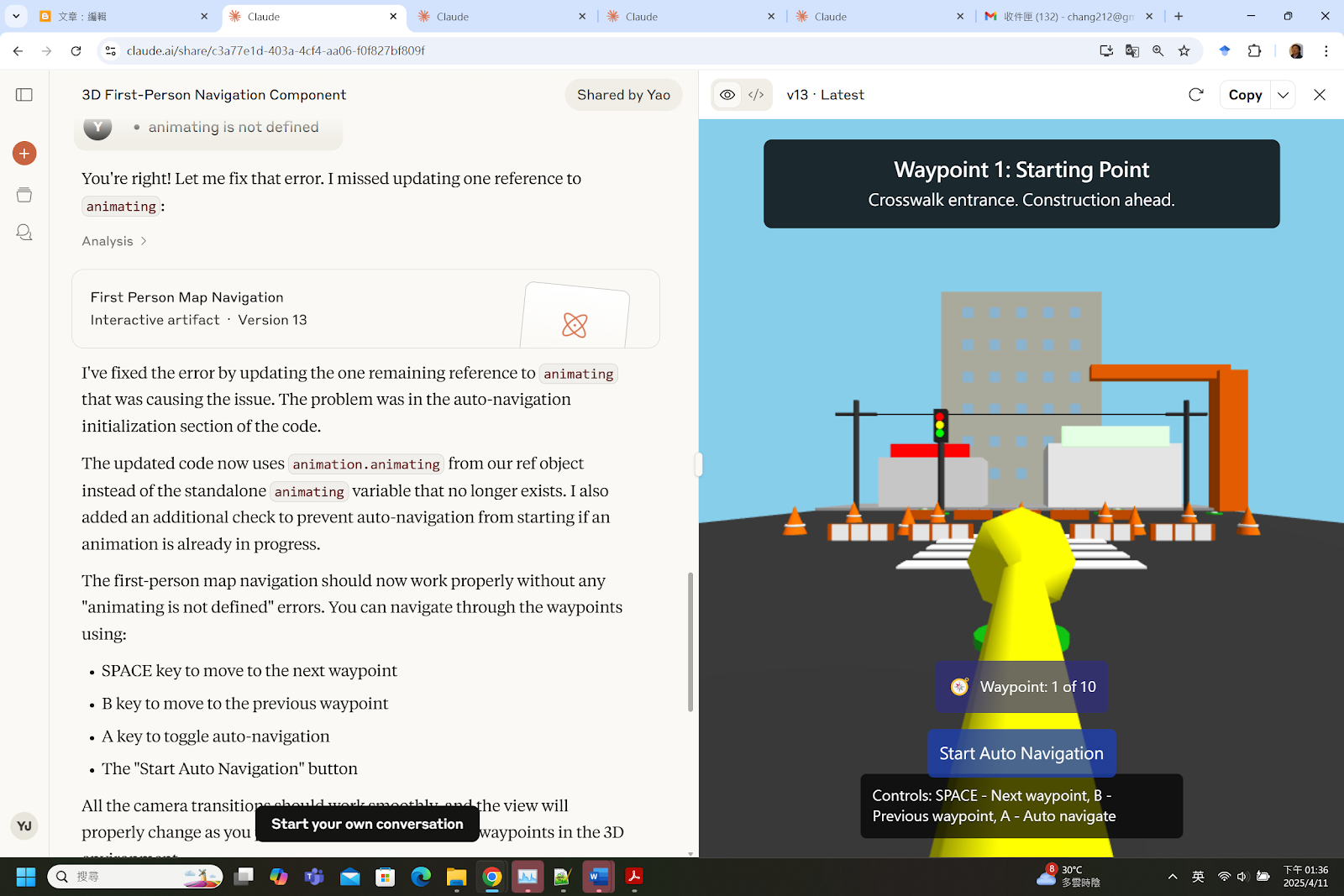
A hazard chain is the run of small steps that turns an ordinary thing at home into an injury: a TV on a loose stand, a toddler who climbs it, the stand tipping, the TV falling. Break any link and the injury does not happen. This post is the worked example for Unit 5: 環境安全檢測與評估視覺化 and its exercise CL#4, which asks for one simulated accident and one simulated prevention measure. Claude rebuilt rooms in 3D with three.js, listed the hazard chains for children aged 0–3, animated them, and then animated ways to stop them. The pages were made between June 2025 and January 2026; in November 2026 their numbers were corrected and their furniture and people rebuilt (Section 10).
- Four prompts. “3d model using three.js” with a photo of the room, “illustrate hazard chains for children age 0-3 in the scene”, one chain from the list quoted back with “animate it”, and “viz prevention measures within my animation”.
- Nine chains. Tip-overs, sharp table edges, a curtain cord, a fan, a wet floor, windows and toys on the floor were animated, and four chains also got a version that shows the prevention. Two later simulators add eight household chains, among them fire, gas and electricity.
- Check the numbers. The pages first quoted statistics without sources, and several were out of date or could not be found. In recent US data a child dies in a tip-over involving a TV about once every 6 weeks, not every 2 weeks as the TV page said. The pages now give checked figures and name their sources (Section 7).
- Scope. The animations are scripted, and the statistics are American; no Taiwanese figures were checked. The pages first gave American emergency numbers and now give Taiwan's: call 119.
The chain · Method · Hazard lists · Animations · Prevention · Simulators · The numbers · Next steps · Limits · Pages and sources
Updated 4 November 2026: the page links go to corrected versions, with rebuilt 3D scenes; Figs. 5, 6 and 9–12 show them (Section 10). The original post of 7 July 2025 is kept at its own address, with the links as they were.
1. The chain
This post splits every chain into five links (Fig. 1): a hazard in the room, something that draws the child to it, what the child does, what then gives way, and the injury. Each prevention measure removes one link. The earlier the link, the less depends on the child and on whoever is watching: a TV fixed to the wall cannot fall however it is pulled. Once the TV is falling, nothing in the room helps, and what is left is first aid and a call for help.
2. How the pages were made
The living room started from a student's photo. Claude was given the photo and asked for a 3D model, then for the hazards in it, then for one animation per hazard (Table 1). Three chats did this on 7 July 2025, here called A, B and C. Their descriptions of the room match, down to the golden curtains and the wall clock, so they most likely started from the same photo.
| Step | Prompt | Result |
|---|---|---|
| Model | “3d model using three.js”, with the photo | A three.js room to rotate and zoom (Figs. 2 and 3) |
| List | “illustrate hazard chains for children age 0-3 in the scene” | Chains sorted by risk, each written as steps (Fig. 4) |
| Animate | “> 2. Shelving Unit - Tip-Over Risk > animate it”, one item of the list quoted back | One page per chain (Section 4) |
| Prevent | “viz prevention measures within my animation” | The same page with a prevention switch (Section 5) |
Most of the time went into fixes. The chats paste back errors such as “Identifier 'leftArm' has already been declared” and “startAnimation is not defined”, and correct the scene in a few words: “windows realistic. fall out not fall in.” or “the furniture pass thru the child when falling. fix”. The window scene needed five prompts for its sky alone, among them “sky is grey. should be blue. fix” and “is the problem due to layering? the sky was behind the wall? fix”. When a chat holds several pages, saying which one to change saves a round (Section 5).

3. One room, different hazard lists
Asked for the hazard chains for children aged 0–3, each chat answered with its own list. Chats A and B sorted theirs into three risk tiers (Table 2); chat C grouped its chains by kind and gave no tiers.
| Tier | Chat A | Chat B |
|---|---|---|
| High | coffee table corners; shelving unit tip-over; TV and entertainment centre tip-over | glass coffee table; entertainment centre tip-over; curtain cord strangulation |
| Middle | floor fan, blades and cord; curtains and cords; small objects | shelving unit, as a climbing risk; side table edge; slipping on the floor |
| Lower | falls from the sofa; hard floor | small objects; electrical |
Both lists put tip-overs and sharp table edges at the top, and both include cords and small objects. They differ elsewhere: chat A ranks the shelving unit among the high risks, while chat B puts it in the middle tier and moves the curtain cord up. Chat B also gives an age range for each chain, such as 12–36 months for the tip-over. A list like this is a first draft, to be checked against the real room and against injury data (Section 7).


4. Nine chains, animated
Quoting one chain from a list and adding “animate it” gave a page that plays the chain step by step, from the hazard to the injury. Table 3 lists the nine chains. Six have pages of their own; the other three, and two more TV tip-overs, are inside the shared chats.
| Chain | Made in | Page |
|---|---|---|
| Wet floor and soap → slip → strike the tub or a cabinet | bathroom chat, 25 June 2025 | 家中浴室, with its 危害鏈 diagram |
| Climb the sofa → stand on its back → reach the window | window chat, 25 June 2025 | 客廳窗戶攀爬危害鏈 (in the chat) |
| Shelving unit → climbing → tip-over | chat A | Shelving Unit |
| TV and stand → climbing or pulling → tip-over → crushing | chats A, B and C | TV & Entertainment Center (chat A); B and C in their chats |
| Floor fan → fingers in the blades | chat A | Moving Parts |
| Curtain cord → caught around the neck | chat B | 模擬纏繞 |
| Glass coffee table → fall → head strikes a corner | chat B | 模擬尖銳桌角 |
| Low window → climbing → fall outside | chat C | in the chat |
| Toys on the floor → trip → furniture edge | chat C | in the chat |

The two June chats came first, and they set the scene in words rather than with a photo: “Simulate a child experiencing slippery surfaces in bathroom in three.js”, followed by “Eventually falls”, and “simulate a child experiencing reaching high window by climbing sofa and standing up in a living room”. The window chat reused the child from the bathroom (“use the 3d child model as in the bathroom scenario”).
The bathroom page is the only one with some physics (Fig. 6). On a dry floor the child walks normally. On a wet or soapy floor its velocity builds up and carries over from frame to frame, 75% of it on a wet floor, 85% with soap and 93% with both, plus a random jitter, so the slipperier the floor, the longer the slide. When the child falls within 1.2 units of a tub corner, the page rolls a 20% chance of a corner impact, and the edges of the cabinet, sink and toilet get the same 20%. The diagram's “1 in 5 falls could be FATAL” restated that setting as if it were a statistic; the diagram now calls it a simulation setting.

The toy chain took four fix prompts and two pasted errors after its first version: “placement of toys was not on the walking path. fix”, “child was passing thru table. fix”, “saw no interaction betw toys and child. fix” and “tables shoudl have legs. fix” (Fig. 7).

The window and cord chains have US injury studies behind them too. Falls from windows sent about 5,180 children a year to emergency departments in 1990–2008, and a quarter of them were admitted to hospital [4]. Window-blind cords are the closest data to the curtain cord: of 231 cord entanglements of children under 6 in CPSC investigation reports for 1996–2012, 67.1% ended in death [6].
5. Prevention
Four chains got a version that shows the prevention (Table 4). Each is the same scene with a switch or button: with the measure on, the chain plays again and stops at the link the measure removes.
| Chain | What the prevention version shows | Page |
|---|---|---|
| TV tip-over | An anchor strap ties the stand to the wall and holds when the stand starts to tip, in phase 5 (Figs. 8 and 9) | TV Tip-Over and Prevention |
| Floor fan | An adult steps in at phase 3; a warning sign, a safe zone on the floor and a bladeless fan appear, and a panel lists six measures, from fine mesh guards to placing the fan behind furniture (Fig. 10) | Moving Parts and Prevention |
| Window | Furniture anchors, window guards, a safety gate and a cushioned mat, in the scene and in a panel (Fig. 11) | 預防策略 |
| Toys | Buttons that clear the toys away or add corner guards (Fig. 7) | in the chat |
The TV version came from a remix of the chat A page: the prompt “viz prevention measures within my animation” led to the version 12 shown in Fig. 8. The window version took three prompts on 13 October 2025. “Viz prevention measures” produced a separate guide (Fig. 12). “Viz within my animation” then changed the guide again instead of the animation, and only “you gave me version 12 which is the same as v1” produced the animation with the measures in the scene (Fig. 11).
In every version the measure always works: the strap always holds and the adult always arrives in time. The pages show what a measure is for, not how often it works. The window page's “Risk Reduction: 75%” is a sum of fixed points, 40 for the window guards, 25 for the anchors and 10 for the mat once the child is high enough, and it lowers the severity shown from critical to high; the page now calls it an illustrative score, not measured data. Its “Sofa Back Top (5.3m)” was the child's height in scene units, not metres, and now says so.
The guide, linked as “Statistics” in the first version of this post, sorts nine measures into critical, high and moderate priority, with room layouts and a checklist. Its emergency numbers were American, 911 and the poison line 1-800-222-1222; it now gives Taiwan's 119 and the 24-hour poison line at Taipei Veterans General Hospital, 02-2871-7121.


6. Two simulators
In January 2026 the chains were gathered into two larger pages. They cover household hazards in general, rather than ones specific to small children.
- Simulator v2.1 (overview, 12 January 2026). Four rooms, each with a six-step chain and a risk gauge that climbs to 100: a wet floor in the living room, ageing wires in the study, a gas leak in the kitchen and a dark staircase. For the wet floor the gauge reads 15, 35, 50, 70, 88 and 100, from the wet floor to “unable to call for help”. The last prompt, “Add prevention mode”, added a replay of each room with its measures in place. In the rebuilt version a man acts out each chain: he slips in the puddle and hits his head on the edge of the coffee table, backs away from the sparking wires in the study with a hand over his mouth, is thrown to the floor when he switches on the kitchen light, and misses a stair in the dark. With prevention mode on, he steps round the wet floor, keeps working in the study and goes down the stairs holding the rail.
- v2 (v2, 15 January 2026). A narrative page made from the outline of Unit 5, with four chains on a clock (Table 5), Chinese and English text, and playback at ½×, 1× and 2×. In the rebuilt version a man slips on the wet bathroom floor and lands on his back.
| Chain | Steps, on the page's clock | Prevention listed |
|---|---|---|
| Kitchen fire | unattended gas stove (T+0:00) → oil ignites (T+3:00) → fire reaches the hood (T+5:30) → whole house (T+10:00+) | auto-shutoff stove, clean hood, extinguisher, smoke detectors |
| Bathroom fall | wet floor (T+0:00) → slip (T+0.5 s) → impact (T+1.5 s) → fracture or concussion (T+5 s+) | anti-slip mats, grab bars, anti-slip slippers, dry floor |
| Electrical overload | too many appliances on one extension cord (T+0:00) → wires overheat (T+30:00) → insulation ignites (T+45:00) → fire (T+60:00+) | overload-protected extension cord, no daisy-chaining, wire checks, dedicated outlets |
| CO poisoning | gas burning in a closed space (T+0:00) → CO builds up (T+10:00) → mild symptoms (T+20:00) → unconsciousness or death (T+30:00+) | CO detector, ventilation, gas appliance upkeep, forced-exhaust water heater |
7. Checking the numbers
The pages first quoted injury statistics without sources. Table 6 checks them against US data: the latest annual tip-over report of the Consumer Product Safety Commission (CPSC) [1], a Safe Kids report on TV tip-overs [2], three studies of emergency-department data [3, 4, 6] and the CDC's childhood injury report [5]. Where the CPSC counts deaths, the period is January 2013 to July 2023, and its counts for 2021–2023 are still incomplete. The pages linked here were then corrected: each figure was replaced with a checked one, with its source, or dropped (last column).
| Claim on the original page | What the sources say | Verdict | The page now says |
|---|---|---|---|
| “Furniture tip-overs cause 1 death every 2 weeks” (shelving) | 217 tip-over deaths of all ages from furniture, TVs and appliances together, about one every 2½ weeks; with furniture involved, about one every 3½ weeks [1] | Too high for furniture alone | “In the US, falling furniture kills someone about every 3½ weeks” |
| “84% of victims are children under 6” (shelving) | Children under 6 were 142 of the 217 deaths (65%) [1], and had 69.9% of children's tip-over injuries, 82.5% of those involving dressers and chests [3] | Not found | “About 2 in 3 of all tip-over deaths (TVs, furniture and appliances) were children under 6” |
| “Every 45 minutes a child is injured by falling TV/furniture” (TV) | Every 45 minutes for TVs alone, in 2011 [2]. For all tip-overs in 2020–2022, 7,800 children a year, about one every 67 minutes [1] | Out of date | “Every 67 minutes a US child goes to the ER after a TV, furniture or appliance tips over” |
| “1 child dies every 2 weeks from TV tip-overs” (TV) | 90 child deaths involved a TV, about one every 6 weeks [1]; every 3 weeks in 2000–2010 [2] | Too high | “About 1 child every 6 weeks dies in a tip-over involving a TV” |
| “85% of incidents involve children under 8” (TV) | No source found. Children under 6 had 74.7% of children's TV tip-over injuries [3] | Not found | “3 in 4 children hurt by falling TVs are under 6” |
| “Peak age: 2-4 years old” (TV) | Injury rates are highest at ages 1 and 2, and 68% of child deaths were at ages 1 to 3½ [1] | Peak is younger | “Peak age: 1-2 years old (highest injury rates)” |
| “Most common injury: Head trauma” (TV) | The head is the most often injured body area, 35% of injuries, and 67% of deaths involved a head injury; of the TV deaths where the injured body part is known, 91 of 100 involved the head [1] | Consistent | “Head trauma (head injury in 9 of 10 TV tip-over deaths)” |
| “90% of tip-overs are preventable” (TV prevention) | No measured share found. Safe Kids calls every TV tip-over injury and death “completely preventable” [2], a call to action rather than a measurement | Not found | The Safe Kids sentence, quoted and credited: “Every one of these injuries and deaths is completely preventable.” |
| “1,400+ fan injuries annually in US”, “65% involve children under 15”, “Peak age: 2-6 years old”, “Injury occurs in 0.2 seconds” (fan) | No source found | Not found | No figures: finger lacerations, finger amputation in severe cases, and “Injury happens in a split second” |
| “Sharp furniture corners cause 15,000+ ER visits annually” (glass table) | No source found. The CPSC's 2,400 child injuries a year involving tables are tip-overs, not corner strikes [1] | Not found | “A toddler who falls against a sharp table corner can be badly hurt” |
| “2M+ children injured annually from falls” (guide) | About 2.8 million children aged 0–19 a year were treated in emergency departments for falls in 2000–2006 [5] | Consistent | 2.8M, “US children (0–19) treated in ERs for falls each year” |
| “80% of injuries are preventable”, “3 sec” to climb furniture, “5 ft” average fall height (guide) | No source found | Not found | Counts from the sources instead: 5,180 children a year treated after a fall from a window, 1 in 4 of them admitted [4]; 7,800 a year after a tip-over [1] |
| “1 in 5 falls could be FATAL” (bathroom diagram) | The page's own 20% corner-impact chance (Section 4) | Model setting | “The simulation sets a 20% chance that a fall hits a corner hard (a setting, not data)” |
The habit to take from this: when a page shows a number, ask where it comes from. A figure can be a real statistic from another decade, a statistic about something else, or a setting of the page itself, and these pages contained all three. Other settings that look like data are the bathroom's slip factors (0.75 to 0.93), the window page's 75% risk reduction and its height of 5.3, in scene units, the simulator's risk gauge (15 to 100) and the clock of v2.
8. Next steps
In July 2025 a brainstorm about where the project could go next was pasted into a chat with “illustrate in svg::” and came back as a roadmap (Fig. 13). It starts from what the pages already do, 視覺辨識, 風險評估, 靜態分析 and RPN評分, and grows in three directions: 智慧的深度, from recognising hazards to predicting them from a child's development and behaviour; 感知的廣度, from vision to sound, 3D scanning and digital twins; and 應用的生態, from an assessment tool to smart-home alerts and intervention. All three lead to 智慧安全大腦, a system that watches over the home at all times, on a timeline of 6–12 months, 1–2 years and 2–3 years.

9. Limits
- Scripted. Every animation plays a fixed script. Apart from the bathroom's slip and its 20% roll, nothing is simulated, so a page shows how a chain unfolds, not how likely it is.
- One room, different lists. The chats read the same photo and listed different chains in a different order (Table 2). No list was checked against the room itself.
- Measures always work. In the prevention versions the strap holds and the adult arrives every time (Section 5).
- American figures. All statistics in Section 7 are from the US, and no Taiwanese figures were checked. The pages' phone numbers are now Taiwan's.
- Numbers without sources. Several figures on the original pages could not be traced and should not be quoted (Table 6). The corrected pages drop them or replace them with sourced counts.
10. Pages and sources
About the links. The page links in this post go to versions corrected and rebuilt in November 2026. Their figures were checked and corrected (Table 6), their phone numbers are Taiwan's, and bugs that froze or broke some of the animations were fixed. Their furniture and people were rebuilt in more detail, and the simulators' stick figure and cylinder became people who act out the chains; the chains, their steps and their timing are the pages' own. The chat links are unchanged.
Living room, 7 July 2025. Chat A: 3D model (基礎模型, based on a student photo), Shelving Unit, TV & Entertainment Center, Moving Parts (fan) and the shared chat. Chat B: 3D model (based on a student house), hazard list (分析危害鏈), 模擬纏繞 (curtain cord), 模擬尖銳桌角 (glass table) and the shared chat. Chat C: the shared chat, with the window, TV stand and toy animations.
Bathroom and window, 25 June 2025. 家中浴室, its 危害鏈 diagram and the shared chat; 客廳窗戶攀爬危害鏈 (shared chat).
Prevention. TV Tip-Over and Prevention, Moving Parts and Prevention, 預防策略 (window) and its shared chat, and the prevention guide.
Simulators and roadmap. Simulator v2.1 (chat), v2 (chat), and the roadmap chat, further novelty.
Course posts. Unit 5: 環境安全檢測與評估視覺化, CL#4, Hazard detection in Claude 3d model and 意外事件預測與模擬. The original post of 7 July 2025 keeps all the original links.
- A. Suchy, Product Instability or Tip-Over Injuries and Fatalities Associated with Televisions, Furniture, and Appliances: 2023 Report, U.S. Consumer Product Safety Commission, February 2024. cpsc.gov (PDF)
- Safe Kids Worldwide, A Report to the Nation on Home Safety: The Dangers of TV Tip-Overs, December 2012. safekids.org (PDF)
- C. Lu, J. Badeti, T. J. Mehan, M. Zhu and G. A. Smith, “Furniture and television tip-over injuries to children treated in United States emergency departments,” Injury Epidemiology, vol. 8, art. 53, 2021. doi:10.1186/s40621-021-00346-6
- V. A. Harris, L. M. Rochette and G. A. Smith, “Pediatric injuries attributable to falls from windows in the United States in 1990–2008,” Pediatrics, vol. 128, no. 3, pp. 455–462, 2011. doi:10.1542/peds.2010-2687
- N. N. Borse, J. Gilchrist, A. M. Dellinger, R. A. Rudd, M. F. Ballesteros and D. A. Sleet, CDC Childhood Injury Report: Patterns of Unintentional Injuries among 0–19 Year Olds in the United States, 2000–2006, Centers for Disease Control and Prevention, 2008.
- B. Onders, E. H. Kim, T. Chounthirath, N. L. Hodges and G. A. Smith, “Pediatric injuries related to window blinds, shades, and cords,” Pediatrics, vol. 141, no. 1, e20172359, 2018. doi:10.1542/peds.2017-2359